
Pinku
·
15 Oct 2026
·
7 min read
Gross Speed vs Net Speed in Typing: What the Difference Means for Govt Exams
Gross speed counts every keystroke typed. Net speed deducts error penalties. Govt exams score you on net — here is exactly how the gap is calculated across SSC, Railway, and more.

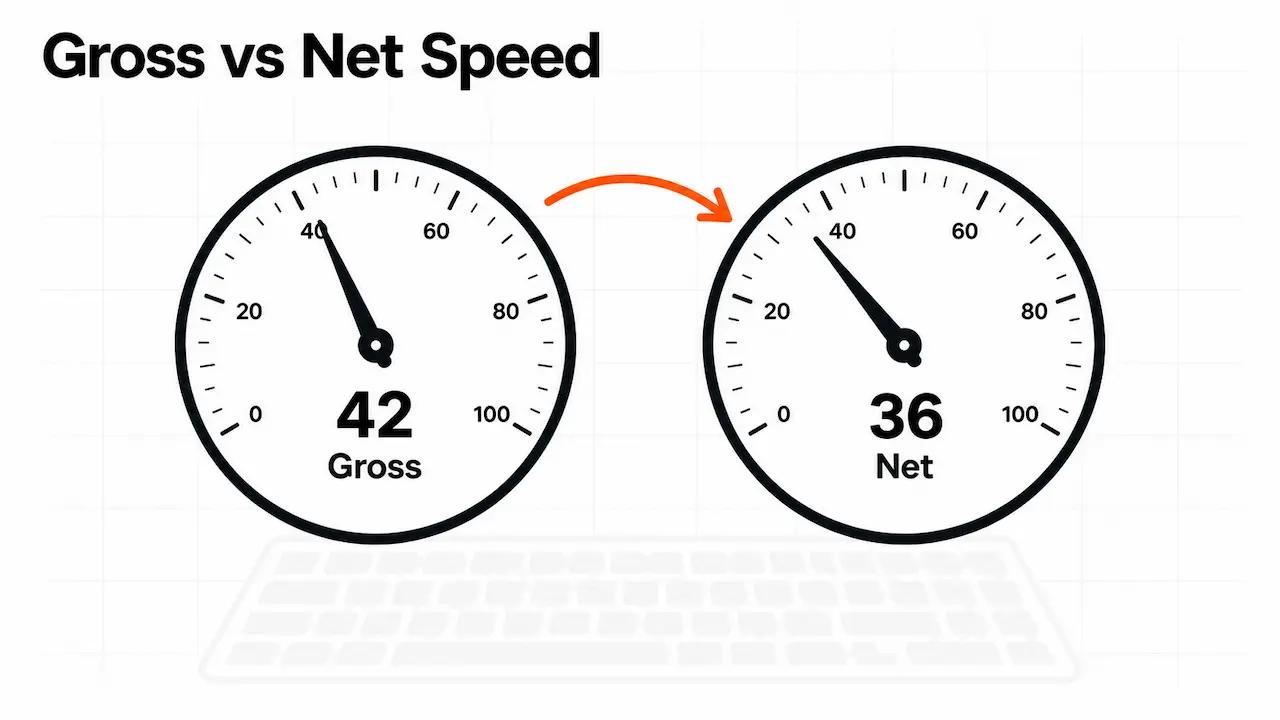
You finish a typing test and see two numbers: Gross Speed 42 WPM, Net Speed 36 WPM. Six words per minute vanished. Where did they go? Understanding the difference between gross speed and net speed is not optional for government exam preparation — it directly determines whether you pass or fail, because every Indian govt typing test scores you on net speed, not gross.
What Is Gross Speed?
Gross speed is the total number of words typed per minute, counting every keystroke — correct or incorrect — with no penalty applied. It measures your raw throughput: how fast your fingers move, not how accurately.
Formula: Gross WPM = Total keystrokes typed ÷ 5 ÷ minutes elapsed
If you type 2,100 keystrokes in 10 minutes, your gross speed is 2,100 ÷ 5 ÷ 10 = 42 WPM. It does not matter how many of those keystrokes were wrong.
What Is Net Speed?
Net speed is your gross speed minus a penalty for errors. This is the number that actually decides whether you pass a government typing test. Every official exam — SSC, Railway RRB, KVS, Army, Courts — uses net speed as the qualifying metric.
Formula: Net WPM = (Total words typed − Error penalty) ÷ minutes elapsed
The error penalty varies by exam — this is where most candidates get confused.
Gross Speed vs Net Speed: Side-by-Side
Gross vs net speed — key differences
| Factor | Gross Speed | Net Speed |
|---|---|---|
| Definition | Total words typed per minute | Words per minute after error deductions |
| Counts errors? | No — errors included in total | Yes — errors reduce the score |
| Used in govt exams? | No — for reference only | Yes — this is the qualifying score |
| Always lower than the other? | Always higher or equal | Always lower or equal |
| What it tells you | How fast your fingers move | How accurately and efficiently you type |
| Example | 42 WPM gross | 36 WPM net (after 6 errors at 1 WPM each) |
How Error Penalties Differ Across Govt Exams
The gap between gross and net speed depends entirely on how the exam penalises errors. Three different systems are used across central and state exams — and mixing them up is one of the most common preparation mistakes.
Error penalty systems used in major Indian govt typing exams
| Exam | Error System | Penalty Per Mistake | Impact on Net Speed |
|---|---|---|---|
| SSC CHSL / CGL | Half-mistake (0.5 word deduction) | −0.5 words per error | 10 errors at 42 WPM gross → 41.5 WPM net — very forgiving |
| RRB NTPC / Railway | 5% free buffer, then full-word deduction | 0 up to 5%, then −1 word per error beyond | 10 errors on 200 words: 0 penalty. 20 errors: −10 words net |
| KVS / EMRS JSA | Percentage formula | Errors ÷ Gross Words × 100 must stay below limit | Error % checked against 7% limit — exceed it and you fail regardless of speed |
| Supreme Court (JCA, PA) | Strict percentage | Must stay within 3% error limit | 3 errors in 100 words typed = borderline. 4 errors = disqualified |
| MP CPCT | Scaled score | Net WPM converted to 0–100 scale, min 50% | A candidate at 28 WPM net can still score 50%+ if accuracy is clean |
| Army Agniveer Clerk | Percentage-based | 5% error limit overall | Similar to KVS — exceed the limit and net speed becomes irrelevant |
Worked Example: Same Typist, Different Results
Rahul types 420 words in 10 minutes with 15 errors. His gross speed is 42 WPM. Watch how his net speed changes across three different exams:
Same gross speed, different net scores across exams
| Exam | Gross WPM | Errors | Net WPM Calculation | Net WPM | Pass/Fail (35 WPM cutoff) |
|---|---|---|---|---|---|
| SSC CHSL | 42 | 15 | (420 − 7.5) ÷ 10 | 41.3 WPM | ✅ Pass |
| RRB NTPC | 42 | 15 | 5% of 420 = 21 words free. 15 < 21, no deduction | 42 WPM | ✅ Pass |
| Supreme Court JCA | 42 | 15 | 15 ÷ 420 = 3.57% error rate > 3% limit | Disqualified | ❌ Fail |
Rahul is fast enough for all three exams based on gross speed alone. He passes two and fails one — purely because of how the error penalty is applied. The exam you target matters as much as the speed you build.
Why Gross Speed Still Matters for Practice
Gross speed is not just a vanity number. Tracking it during practice helps you separate two different problems:
- Low gross, low net — your fingers are slow. Focus on speed drills, home-row technique, and reducing hesitation on unfamiliar keys.
- High gross, low net — your fingers are fast but sloppy. You are rushing. Slow down 5 WPM, fix accuracy first, then rebuild speed.
- Gross and net close together — your accuracy is strong. This is the ideal state. Now push gross speed up and net follows.
A good benchmark: keep your net speed within 5% of your gross speed. If your gross is 42 WPM and your net is 36 WPM, you are losing 14% to errors — too high for any strict exam.
Gross Speed, Net Speed, and KDPH: How They Connect
Indian government exams report scores in KDPH (Key Depressions Per Hour), not WPM. The conversion is straightforward: multiply net WPM by 300 to get net KDPH.
WPM to KDPH conversion — gross and net
| Speed | WPM | KDPH | Exam Benchmark |
|---|---|---|---|
| Gross (42 WPM example) | 42 WPM | 12,600 KDPH | — |
| Net (SSC half-mistake) | 41.3 WPM | 12,390 KDPH | SSC CHSL cutoff: 8,000 KDPH ✅ |
| SSC CHSL minimum | 26.7 WPM | 8,000 KDPH | Minimum to qualify |
| SSC CHSL safe target | 35 WPM | 10,500 KDPH | Buffer above cutoff recommended |
| SSC CGL DEO minimum | 50 WPM | 15,000 KDPH | Hardest SSC typing target |
Your exam scorecard will always show the net KDPH — after error deductions. Use the WPM to KDPH converter to check where your current net speed sits against your target exam cutoff before the exam day.
What to Do With This
Every practice session, check both numbers. If gross and net are far apart, accuracy is your problem. If both are below your exam cutoff, speed is your problem. Target the right thing and your preparation time goes further.
VectorTyping shows you both gross and net speed after every test, along with a breakdown of which words caused errors. Practice on the exact exam pattern — same interface, same passage difficulty, same backspace rules — so the gap between your practice net speed and your exam net speed is as small as possible.
Keep learning
Continue Reading
More articles on exam-guide
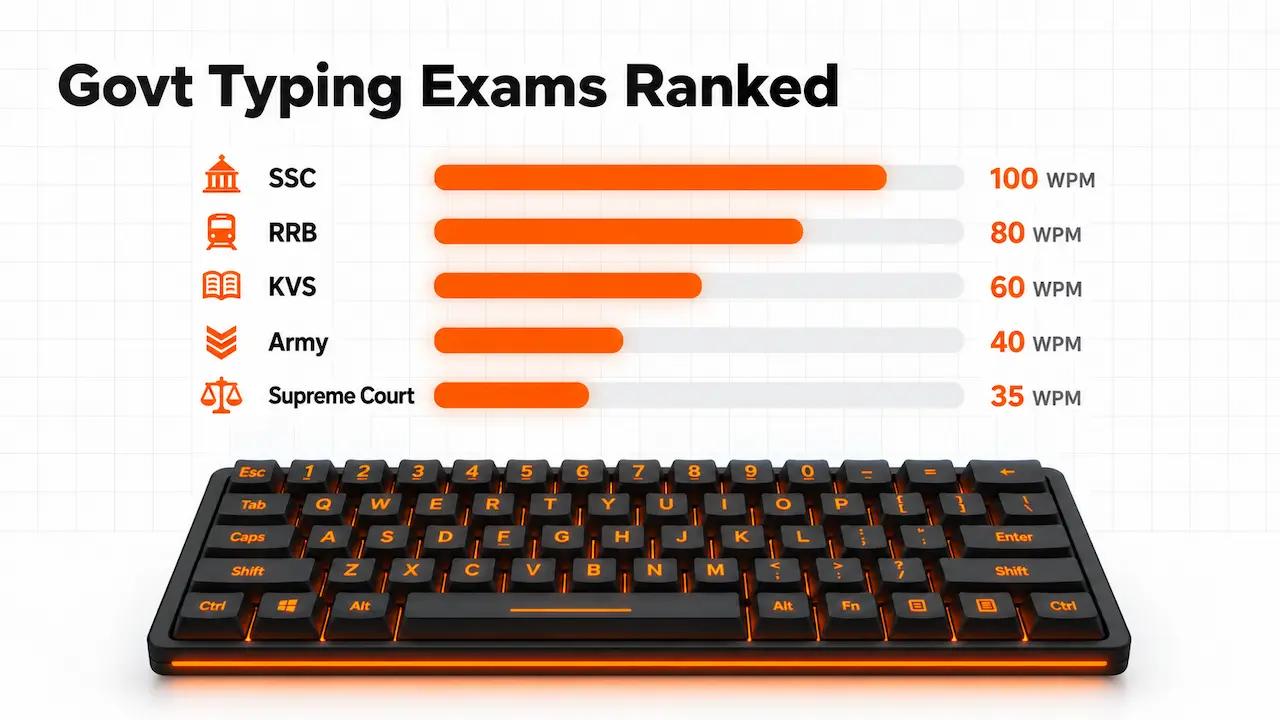
Govt Exam Typing Test 2026: WPM Requirements, Error Limits & Difficulty Ranked
Compare WPM requirements, error limits, and difficulty across 15 major govt typing exams — SSC, Railway, KVS, Supreme Court, Army, and more — in one guide.
Pinku
·
13 Oct 2026
8 min read
Read

Complete SSC Typing Test Guide 2025-26: CHSL, CGL DEO Speed Requirements & Plan
Everything about SSC CHSL and CGL typing tests — LDC 35 WPM, DEO 8,000 KPH requirements, Hindi Inscript rules, scoring formula, and a 30-day preparation plan.
VectorTyping Team
·
25 Feb 2026
9 min read
Read
Free to start · No sign-up required
Ready to improve your typing speed?
Practice SSC, Railway, Banking, Hindi & English typing with real exam passages and live WPM tracking.
10K+
Passages
50+
Exam patterns
100%*
Free forever