
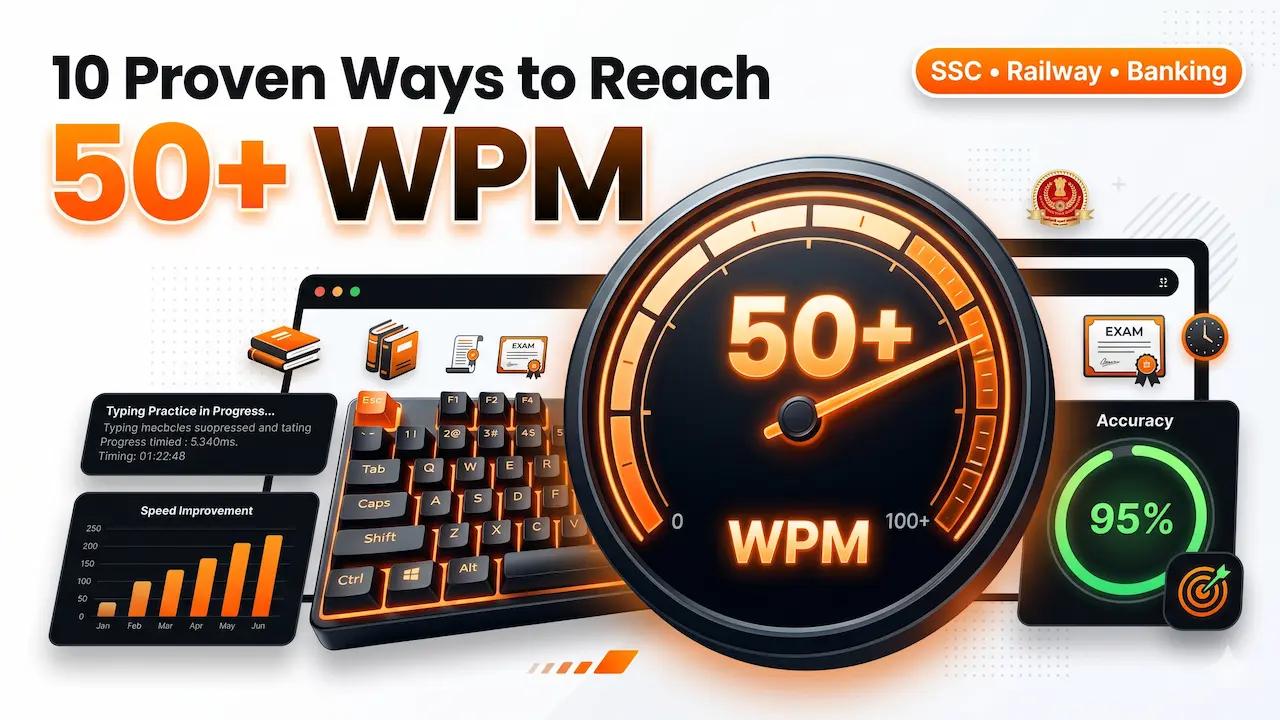
10 Proven Tips to Improve Typing Speed for Government Exams
Master the art of fast typing with these expert-tested techniques. Learn how successful candidates improved from 25 WPM to 50+ WPM in just 3 months.
VectorTyping Team
15 Feb 2026
8 min read
Why Typing Speed Matters for Government Exams
In competitive government examinations such as SSC, Railway, Banking, and other clerical recruitment exams, typing speed is often a qualifying requirement. Candidates are expected to meet specific speed and accuracy standards within a limited time.
Improving your typing speed not only helps you clear the typing test but also increases your confidence during the examination.
The good news is that typing is a skill that can be developed through structured practice and consistency.
1. Master the Home Row Position
Fast typing begins with proper finger placement.
Place your fingers on the home row:
- Left hand: A, S, D, F
- Right hand: J, K, L, ;
- Thumbs: Space bar
This position minimizes finger movement and allows you to reach all keys efficiently.
Why It Works
- Improves finger coordination
- Reduces unnecessary movement
- Builds long-term typing speed
2. Focus on Accuracy Before Speed
One of the biggest mistakes beginners make is trying to type fast too soon.
Instead:
- Start slowly.
- Focus on typing every word correctly.
- Increase speed gradually.
In most government typing tests, accuracy is just as important as speed. Developing correct habits early leads to faster progress later.
Remember: Accuracy creates speed. Speed does not create accuracy.
3. Practice for 30 Minutes Every Day
Consistency is more important than intensity.
A daily 30-minute practice session is often more effective than several hours of practice once a week.
Suggested Routine
- 10 minutes: Accuracy exercises
- 10 minutes: Speed-building drills
- 10 minutes: Timed practice tests
Regular practice strengthens muscle memory and improves typing efficiency.
4. Practice with Exam-Oriented Passages
The content you practice matters.
Instead of typing random quotes or stories, practice with passages similar to those used in SSC, Railway, Banking, and other government recruitment exams.
Why Exam-Oriented Practice Works
- Familiarizes you with formal and administrative language
- Improves recognition of commonly used government terminology
- Builds confidence for real exam conditions
- Helps you develop speed and accuracy on relevant content
VectorTyping provides thousands of exam-specific typing passages, realistic mock tests, and exam-mode practice designed for SSC, Railway, Banking, and other government recruitment exams.
The closer your practice environment is to the actual exam, the better your performance is likely to be on test day.
5. Track Your Progress
Keep a record of your:
- Words Per Minute (WPM)
- Accuracy percentage
- Daily practice time
Tracking progress helps you:
- Identify strengths and weaknesses
- Stay motivated
- Measure improvement over time
Most candidates notice meaningful improvement within a few weeks of consistent practice.
Simple Tracking Example
WeekSpeedAccuracyWeek 122 WPM90%Week 228 WPM92%Week 333 WPM94%Week 438 WPM95%
6. Learn Touch Typing
Touch typing means typing without looking at the keyboard.
This is one of the most important skills for achieving high typing speeds.
How to Practice
- Keep your eyes on the screen.
- Avoid looking at the keyboard.
- Use muscle memory to locate keys.
- Cover the keyboard if necessary during practice.
At first, it may feel slower, but the long-term speed gains are substantial.
7. Take Timed Mock Tests
Typing under pressure is very different from casual practice.
Regular timed tests help you:
- Improve concentration
- Build stamina
- Adapt to exam conditions
- Manage stress effectively
Try taking at least two or three timed mock tests every week.
As your exam approaches, increase the frequency of mock tests.
8. Correct Frequently Repeated Mistakes
Pay attention to words you often mistype.
Common examples include:
- the → teh
- government → goverment
- separate → seperate
- necessary → neccessary
- receive → recieve
Create a personal error list and practice those words repeatedly until typing them becomes automatic.
Small corrections today prevent costly mistakes during the exam.
9. Maintain Proper Posture
Typing speed isn't just about your fingers—it also depends on physical comfort.
Ideal Typing Posture
- Sit upright with proper back support.
- Keep both feet flat on the floor.
- Position the screen at eye level.
- Keep elbows at approximately 90 degrees.
- Relax your shoulders and wrists.
Good posture reduces fatigue and improves performance during longer typing sessions.
10. Stay Motivated and Practice Consistently
Learning any skill becomes easier when you stay accountable.
You can:
- Join typing practice groups.
- Participate in typing challenges.
- Track practice streaks.
- Set weekly goals.
- Compare your progress with previous results.
Consistency over several weeks is the biggest predictor of success.
Expected Improvement Timeline
Every candidate progresses at a different pace, but a typical learning curve looks like this:
Week 1–2
- Learn proper finger placement.
- Focus on accuracy.
- Build typing habits.
- Target: 20–25 WPM
Week 3–4
- Develop basic muscle memory.
- Increase confidence.
- Reduce typing errors.
- Target: 30–35 WPM
Month 2
- Improve speed and consistency.
- Begin taking regular mock tests.
- Strengthen touch typing skills.
- Target: 40–45 WPM
Month 3
- Refine accuracy and endurance.
- Simulate real exam conditions.
- Reach exam-ready performance.
- Target: 50+ WPM with 95%+ accuracy
Common Mistakes to Avoid
Avoid these common errors that slow down progress:
- Looking at the keyboard constantly
- Ignoring accuracy
- Practicing inconsistently
- Using incorrect finger placement
- Skipping timed mock tests
- Typing too fast before developing control
- Failing to review mistakes
Eliminating these habits can significantly accelerate your improvement.
Practice Plan for Beginners
If you're starting from scratch, follow this simple plan:
First Month
- Learn finger placement
- Focus on touch typing
- Practice 20–30 minutes daily
- Prioritize accuracy
Second Month
- Increase speed gradually
- Take weekly mock tests
- Practice exam-oriented passages
Third Month
- Simulate real exam conditions
- Track speed and accuracy closely
- Focus on consistency and confidence
Final Thoughts
Improving typing speed is not about finding shortcuts—it's about building strong habits through consistent practice.
Focus on:
- Correct finger placement
- High accuracy
- Daily practice
- Touch typing
- Regular mock tests
- Exam-oriented content
With the right strategy and consistent effort, reaching government exam typing standards becomes much more achievable.
Remember: The fastest typists aren't the ones who type hardest—they're the ones who practice smartest.
Ready to improve your typing speed?
Practice SSC, Railway, Banking, Hindi Typing, English Typing, and exam-mode mock tests on VectorTyping. Track your speed, accuracy, and progress with thousands of exam-oriented typing passages designed specifically for government exam aspirants.
About this article
Author
VectorTyping Team
Published
15 Feb 2026
Read time
8 min read
Category
Free to start · No sign-up required
Ready to improve your typing speed?
Practice SSC, Railway, Banking, Hindi & English typing with real exam passages and live WPM tracking.
97L+
Aspirants
10K+
Passages
100%
Free forever
Keep learning
Continue Reading
More articles on speed-tips

What Is a Good Typing Speed? WPM Benchmarks by Age & Job (2026)
Wondering what a good typing speed is? Compare your WPM against typing speed benchmarks by age, profession, and skill level. Take a free typing test on VectorTyping.
VectorTyping Team
·
5 Jun 2026
7 min read
Read
How to Type Faster: 7 Proven Tips to Increase Your WPM Speed in 7 Days
Learn how to type faster with 7 proven tips that improve WPM, accuracy, and touch typing skills. Practice smarter with VectorTyping and boost your typing speed in just 7 days.
VectorTyping Team
·
5 Jun 2026
5 min read
Read